19 results for classification system · 3.281s

News for “classification system”
19 results • 3278 ms server time
Sea based rocket net recovery platform enters service for Chinese reusable launchersIMAGE
spacedaily.com• Dec 9, 2025• 1 min read
Sea based rocket net recovery platform enters service for Chinese reusable launchersTokyo, Japan (SPX) Dec 08, 2025 China has taken delivery of its first sea based platform designed to recover rockets using a net system, adding a key element to national plans for reusable launch vehicles. The vessel, named Linghangzhe or Pathfinder, has been certified by the China Classification Society, becoming the first sea based rocket recovery platform in the country to receive the required class and statutory appr
Stephanie Getty: Exploring the Universe with Curiosity and WonderIMAGE
nasa.gov• Feb 10, 2025• 1 min read
Stephanie Getty: Exploring the Universe with Curiosity and WonderName: Dr. Stephanie Getty Title: Director of the Solar System Exploration Division, Sciences and Exploration Directorate and Deputy Principal Investigator of the DAVINCI Mission Formal Job Classification: Planetary scientist Organization: Solar System Exploration Division, Sciences and Exploration Directorate (Code 690) What do you do and what is most interesting about your role here at Goddard? […]
Systems Engineer Noosha Haghani Prepped PACE for SpaceIMAGE
nasa.gov• Feb 10, 2025• 1 min read
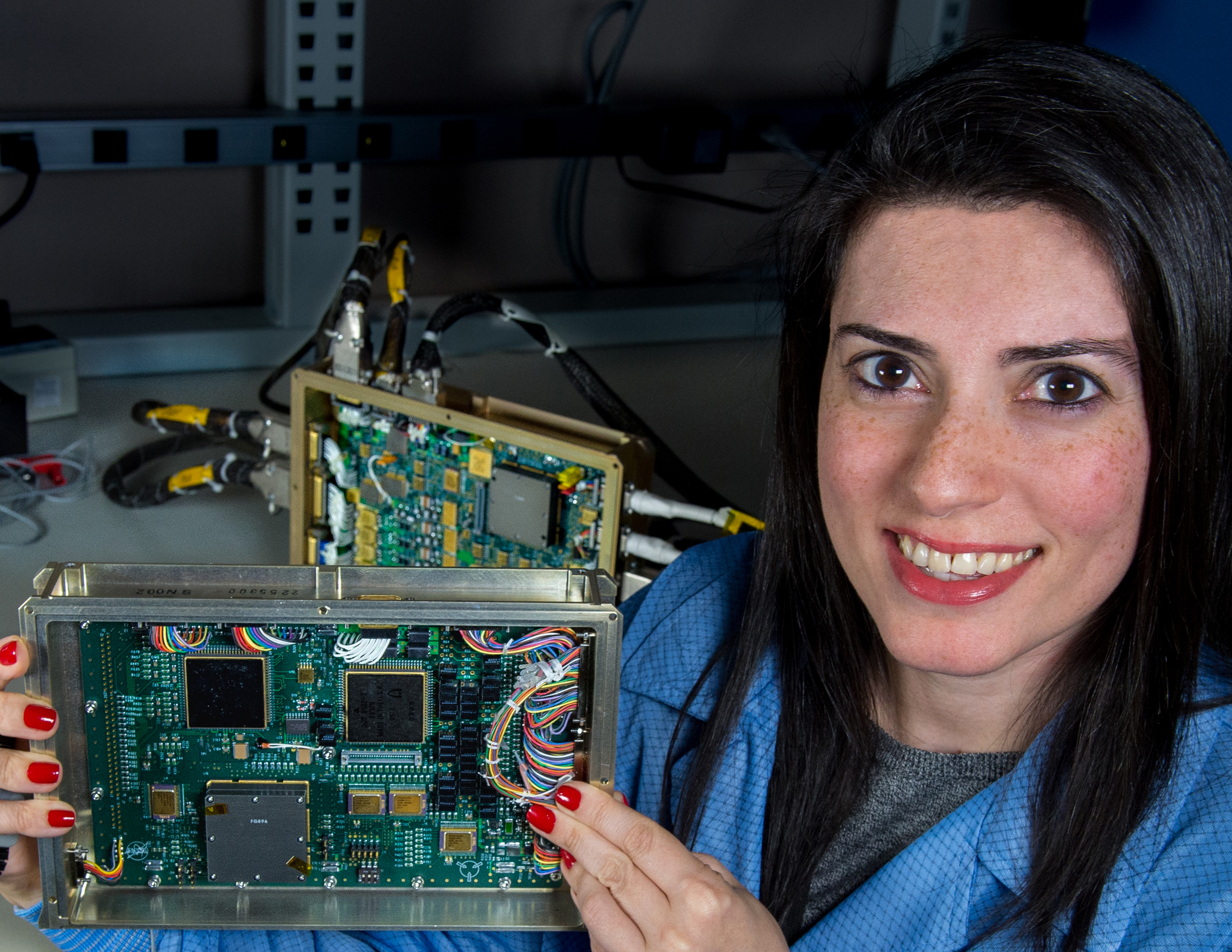
Systems Engineer Noosha Haghani Prepped PACE for SpaceThroughout the life cycles of missions, Goddard engineer Noosha Haghani has championed problem-solving and decision-making to get to flight-ready projects. Name: Noosha HaghaniTitle: Plankton Aerosol Clouds and Ecosystem (PACE) Deputy Mission Systems EngineerFormal Job Classification: Electrical engineerOrganization: Engineering and Technology Directorate, Mission Systems Engineering Branch (Code 599) What do you do and what is most […]
Nargess Memarsadeghi, Computer Engineer for the CosmosIMAGE
nasa.gov• Dec 19, 2024• 1 min read
Nargess Memarsadeghi, Computer Engineer for the CosmosWhen it comes to building spaceflight missions, the software is at least as important as the hardware. For computer engineer Nargess Memarsadeghi, having a hand in the programming is like getting to go along for the ride. Name: Nargess MemarsadeghiTitle: Associate Branch Head, Software Systems Engineering BranchFormal Job Classification: Supervisory Computer EngineerOrganization: Software Systems Engineering […]
Julie Rivera Pérez Bridges Business, STEM to ‘Make the Magic Happen’IMAGE
nasa.gov• Sep 24, 2024• 1 min read
Julie Rivera Pérez Bridges Business, STEM to ‘Make the Magic Happen’Senior Resource Analyst Julie Rivera Pérez ensures finances and assets are in place to enable missions’ engineering and science “magic” can happen. As a former intern, she also reaches out to current students to ensure a diverse and inclusive future workforce. Name: Julie Rivera PérezFormal Job Classification: Senior Resources AnalystOrganization: Systems Review Office/Resource Management Office, […]
Advertisement
Moozonian News
github.com• Jul 23, 2026• 1 min read
Show HN: Chrome Plugin to Scan HN Page Quickly. (Categorize with Local Model)Recently I started spending more time reading HN posts, and engaging. Wanted to scan HN pages faster ,that rosonates to me.For me it is easy to grasp if they are in the order of software stack (Hardware, System, Infrastructure, apps, and so on ).Built this chrome plugin that uses Gemini model, to classify. It works but, classification still not great. It is built using claude code cli.on my Mac book pro, Gemini nano model loading takes around 11 seconds, and classification it self takes around 5 seconds. (if sub classification enabled it adds 6 more seconds approx). Model loaded in background thread. And unloads, if not used after 30 seconds. I would say still not pretty usable, without optimized classification time, but it works, to experiment with.
Moozonian News
news.ycombinator.com• Jun 9, 2026• 1 min read
Launch HN: Transload (YC P26) – Measuring freight items with CCTVHi HN — we’re Julius, Jago, and Nils, and we’re building transload (https://transload.io).transload helps LTL trucking companies measure freight dimensions using the security cameras already installed in their terminals. Instead of sending shipments through a dedicated dimensioning station, we measure them automatically as they move through the normal dock workflow.We’ve put together a small HN-specific demo site here: https://hn.transload.ioIn LTL trucking, dimensions matter because they affect pricing, freight classification, and trailer utilization. If a shipment is larger than the shipper reported, the carrier undercharges for it while still giving up the same amount of trailer space. The obvious fix is to measure every shipment, but thats impossible in a busy freight terminal. Dedicated dimensioning systems work for freight that passes through them, but they add forklift travel, create dock congestion, and change the normal flow of work. In practice, many terminals only measure a
Moozonian News
news.ycombinator.com• Mar 4, 2026• 1 min read
Real-time deepfake detection API and X integration demoWe’ve built a SOTA deepfake detection system (95%+ on in-the-wild content) using adversarial architecture since before 2024 elections. Working to augment X’s media workflow for real-time classification of uploaded/loaded images/videos. Specifically with massive uptick in dangerous ai content about world conflict and wars.How it works: • Media → DB/DOM → API call • Returns: class (real/fake), confidence, C2PA metadata, known image similarity, VLM reasoning Video demo: real-time classification overlay while scrolling X: https://x.com/kenjon/status/2029278211817742738?s=46API docs / extension: docs.bitmind.ai
Moozonian News
sniphi.com• Mar 3, 2026• 1 min read
Show HN: A trainable, modular electronic nose for industrial useHi HN,I’m part of the team building Sniphi.Sniphi is a modular digital nose that uses gas sensors and machine-learning models to convert volatile organic compound (VOC) data into a machine-readable signal that can be integrated into existing QA, monitoring, or automation systems. The system is currently in an R&D phase, but already exists as working hardware and software and is being tested in real environments.The project grew out of earlier collaborations with university researchers on gas sensors and odor classification. What we kept running into was a gap between promising lab results and systems that could actually be deployed, integrated, and maintained in real production environments.One of our core goals was to avoid building a single-purpose device. The same hardware and software stack can be trained for different use cases by changing the training data and models, rather than the physical setup. In that sense, we think of it as a “universal” electronic nose: one platform, mul
Moozonian News
ryvos.dev• Feb 26, 2026• 1 min read
Show HN: Ryvos – Autonomous AI assistant in Rust(15MB RAM,50 tools,16 providers)Hi HN,I've been building Ryvos for the past few months — an open-source autonomous AI assistant written in Rust. It's the thing I wished existed: always-on, multi-channel, and actually secure.The core idea: every tool call passes through a SecurityGate — 5 tiers of classification, 9 dangerous pattern regexes (rm -rf, DROP TABLE, curl|bash, etc.), Docker sandboxing, and human-in-the-loop approval for anything risky. Skills run in Lua/Rhai sandboxes, not raw system code. We've all seen what happens when AI assistants run community code without any vetting.What it does: - Talk to it on Telegram, Discord, Slack, web dashboard, or terminal - 50 built-in tools (shell, file I/O, web search, grep, edit, browser...) - 16 LLM providers (Anthropic, OpenAI, Ollama, Groq, Gemini, Azure, Cohere, Mistral...) - MCP-native (stdio + SSE/Streamable HTTP) - Drop-in skills in Lua/Rhai with sandboxed execution - Ships as a single ~20MB static binary - 15-30MB RAM idleQuick install: curl -fsSL https://raw.gi
Advertisement
Moozonian News
news.ycombinator.com• Feb 21, 2026• 1 min read
Why optimizing AUC may be insufficient for clinical deterioration systemsMedical ML research and competitions often optimize ROC-AUC as the primary performance metric.However, in real hospital environments, the central question is not classification accuracy — it is escalation timing.In deterioration detection systems: • A noisy alert creates alarm fatigue. • A late alert costs lives. • A static classifier may fail to reflect dynamic physiology.I’ve been exploring a framework that introduces: • Dual-threshold activation (high/low) • Temporal stability validation • False-alarm suppression logic • Governed escalation timingThe aim is to shift from probability scoring toward structured decision triggering.I’m curious how others here would approach modeling escalation timing in a clinically responsible way.Would love perspectives from ML engineers and clinicians.
Moozonian News
github.com• Feb 17, 2026• 1 min read
Show HN: Gait – because "what did the AI agent do?" shouldn't require guessworkI run cloud and AI infrastructure at an enterprise. Over the past year agents went from experiments to touching real systems with real credentials. Then one broke. Legal asked what happened. We had logs but no reproducible artifact, no proof of what policy governed the action, no way to show the same inputs would produce the same behavior again. Nobody was building this internally, so I started building it at 11pm after my kids go to bed. Gait is a Go CLI that turns each agent run into a signed pack: a ZIP of versioned JSON with intents, policy decisions, results, and cryptographic verification (Ed25519 + SHA-256).gait verify validates a pack offline. Schema, hashes, signatures. Stable exit codes.gait pack diff compares two packs structurally, including context drift classification.gait run replay reproduces behavior using recorded results as deterministic stubs. No re-executing real API calls at 2am.gait regress bootstrap converts a bad run into a CI fixture. Exit 0 = pass, exit 5 = d
Moozonian News
dsifry.github.io• Jan 17, 2026• 1 min read
Show HN: I built a tool to assist AI agents to know when a PR is good to goI've been using Claude Code heavily, and kept hitting the same issue: the agent would push changes, respond to reviews, wait for CI... but never really know when it was done.It would poll CI in loops. Miss actionable comments buried among 15 CodeRabbit suggestions. Or declare victory while threads were still unresolved.The core problem: no deterministic way for an agent to know a PR is ready to merge.So I built gtg (Good To Go). One command, one answer:$ gtg 123 OK PR #123: READY CI: success (5/5 passed) Threads: 3/3 resolvedIt aggregates CI status, classifies review comments (actionable vs. noise), and tracks thread resolution. Returns JSON for agents or human-readable text.The comment classification is the interesting part — it understands CodeRabbit severity markers, Greptile patterns, Claude's blocking/approval language. "Critical: SQL injection" gets flagged; "Nice refactor!" doesn't.MIT licensed, pure Python. I use this daily in a larger agent orchestration system — would love fe
Moozonian News
news.ycombinator.com• Jan 7, 2026• 1 min read
Why machine learning fails at prioritization problemsWhy Machine Learning Fails at Prioritization ProblemsMachine learning has been enormously successful at perception tasks: vision, speech, translation, classification. But over the last few months, I’ve become convinced it’s the wrong abstraction for a large class of problems that show up in real businesses.These aren’t problems about recognition. They’re problems about prioritization.What I mean by “prioritization problems”In many operational settings, the task isn’t to predict an outcome in isolation. It’s to decide what to act on next given limited time and resources.Examples: • Which customers should a team focus on today? • Which accounts are most at risk right now? • Which leads are worth human attention this week? • Which cases should be escalated first?In practice, these problems reduce to ranking entities, not labeling them. The top of the list matters far more than global accuracy metrics.Why accuracy is a misleading objectiveMost ML systems optimize for accuracy (or AUC, log
Moozonian News
mushroomcheck.com• Nov 13, 2025• 1 min read
Show HN: Guardian for Wild Mushroom SafetyEver stumbled upon a cluster of wild mushrooms in the woods, curious about their species but paralyzed by the fear of toxicity? Tired of letting uncertainty stop you from exploring nature’s edible treasures? Today, we’re thrilled to announce the official launch of MushroomIdentification AI — the cutting-edge intelligent system that turns wild mushroom safety from a worry into a breeze! 1-Second Precision, 1000+ Species Covered No professional mycology knowledge? No tedious manual comparisons? No problem. Simply open MushroomIdentification AI, upload a mushroom image or snap a photo directly, and our advanced AI kicks into gear. In just 1 second, it accurately identifies the mushroom species — covering over 1000+ wild and common varieties. You’ll get more than just a name: we provide scientific classifications, common aliases, detailed morphological features, and natural habitats. Go from a “mushroom novice” to an informed explorer in an instant! Smart Toxicity Analysis: Safety Alerts T
Moozonian News
aestheticrank.com• May 7, 2025• 1 min read
Show HN: Aesthetic Rank – AI-based physique analysis and rankingI built Aesthetic Rank, a web app that uses AI to analyze physique photos and provide detailed feedback. Upload up to 5 photos and get:Tiered ranking system (Iron to Supreme) Detailed muscle group assessments Body ratio analysis and composition metrics Posture and symmetry evaluation "Warrior Archetype" classification Natural vs enhanced assessmentThe AI processes images in under 60 seconds, providing comprehensive reports with actionable insights about genetic potential, sport recommendations, and detailed strengths/weaknesses.
Advertisement
Moozonian News
news.ycombinator.com• Jul 13, 2024• 1 min read
Associative Learning, Books, and VideoI have a little over 6000 books. They are loosely arranged "by subject". Google has a pile of scanned books (although I can't get access).The "by subject" classification is a sorta-useful choice but it mixes my book on invertebrate learning (octopus) with the "biology pile", or the "learning pile", or other "piles". The question becomes "where does it fit"?Currently most of my books (after 1970 or so) have an ISBN but that is related to the publisher, not the subject. The Dewey system helps a little but not all books seem to have a number. Many people gift me books they no longer want so they don't come from libraries (great joy!)I've been toying with the idea of "conceptual distance" but haven't found a way to express or compute it. I've recently been thinking about asking an AI system to generate a "classification in a landscape". Thinking about it, I recently pondered the idea of using an AI to read the table of contents to find and arrange youtube videos for each chapter. Thus a ta

Moozonian News
news.ycombinator.com• Mar 28, 2023• 1 min read
Launch HN: Metal (YC W23) – Embeddings as a ServiceHey HN! We’re Taylor, James and Sergio – the founders of Metal (https://www.getmetal.io/). You can think of Metal as embeddings as a service. We help developers use embeddings without needing to build out infrastructure, storage, or tooling. Here’s a 2-minute overview: https://www.loom.com/share/39fb6df7fd73469eaf20b37248ceed0fIf you’re unfamiliar with embeddings, they are representations of real world data expressed as a vector, where the position of the vector can be compared to other vectors – thereby deriving meaning from the data. They can be used to create things like semantic search, recommender systems, clustering analysis, classification, and more.Working at companies like Datadog, Meta, and Spotify, we found it frustrating to build ML apps. Lack of tooling, infrastructure, and proper abstraction made working with ML tedious and slow. To get features out the door we’ve had to build data ingestion pipelines from scratch, manually maintain live customer datasets, build observabi