Curiosity Blog, Sols 4818-4824: Thinking Out of the BoxworkWritten by Ashley Stroupe, Operations Systems Engineer at NASA’s Jet Propulsion Laboratory Earth planning date: Friday, Feb. 27, 2026 This week we had three planning sessions, exploring the eastern side of the boxwork unit. As a Rover Planner on Monday, I worked on the arm and drive activities, while on Friday I served as the […]
Show HN: Mozilla.ai introduces Clawbolt, an AI Assistant for the tradesHey everyone, Nathan here: I'm an MLE at Mozilla.ai. I can't tell you how many things around my house I've been saying "I would really like to have somebody take a look at that". But here's the problem: all the people in the trades are extremely overwhelmed with work. There is a lot to be done and not enough people to do it.One of my best friends runs his own general contracting business. He's extremely talented and wants to spend his time working on drywall, building staircases, and listening to Mumford and Sons while throwing paint onto a ceiling. But you know what gets in the way of that wonderful lifestyle that all us software engineers dream about?ADMINISTRATION.He thought running his own business would be 85% show up and do the work, but turns out a large chunk of the time is spent talking to clients to schedule time to get an estimate, working with home management companies to explain the details of an invoice, and generally just manage all of the information that he's gathering
Show HN: AI gaming copilot that uses a phone camera instead of screen captureBuilt this as a side project after wanting a real-time gaming companion that could call out macro mistakes / timers / map awareness while I play.*Project Aegis* is an AI gaming companion (starting with League of Legends) that gives spoken advice in real time.The twist: it uses a *physically air-gapped setup*.Why? Some games (especially with strict anti-cheat like Riot Vanguard) make screen capture / memory-reading approaches risky or impractical. So instead of reading the game directly, I point a *smartphone on a tripod at my monitor* and process the video externally.*How it works (current version):** Phone camera points at the game screen * Frames are streamed over WebSockets to a local FastAPI server * OpenCV cleans up glare / perspective issues * Vision model analyzes the frame context * TTS speaks back advice (macro reminders, timers, awareness prompts, etc.)So far this is more of a *working prototype + architecture experiment* than a polished product, but it’s functional and surpr
Show HN: Lysium – cross-platform control plane for agentic software deliveryHi HN — I built Lysium to reduce context-switching when working through GitHub issue/PR queues.Lysium uses GitHub + the Devin API so you can route work to background agents and keep moving. You can: • Swipe issues/PRs to close, merge, or skip • Launch implementation requests from issues/PRs or from a freeform Code tab • Run multiple agent sessions in parallel across repositories • Trigger one-click issue/PR assessments and PR reviews • Track progress in an Activity view split into Sessions and Actions Try it: https://www.lysium.ai/ Code: https://github.com/dabit3/lysiumNo email signup flow; full functionality requires GitHub OAuth plus a Devin API key + org ID.I’d especially appreciate feedback on onboarding friction, general UX, and where agent automation should be explicit vs automatic.
Collaborating Through Data: Inside the PSI Users GroupAbout the PSI Users Group The Physical Sciences Informatics (PSI) Users Group is a recurring Webex forum that brings together researchers, open-science practitioners, and collaborators from across the physical sciences community. Designed to foster collaboration, knowledge-sharing, and data-driven discovery, each meeting provides participants with a platform to directly engage with leading researchers and PIs. Each […]
Show HN: MoodJot – Mood tracker mobile app with community feed, built with KMPMoodJot is a mood tracking app I built solo using Kotlin Multiplatform and Compose Multiplatform. It ships on both iOS and Android from a single codebase.The main differentiator from existing mood trackers (Daylio, DailyBean, etc.) is a community feed where users can share moods and see how others are feeling.Technical details: - Compose Multiplatform for shared UI (31 screens) - GitLive Firebase KMP SDK for Firestore, Auth, Storage - ChatGPT integration for AI mood pattern analysis via Ktor - expect/actual for StoreKit 2 (iOS) and Play Billing 7.0 (Android) - Home screen widgets: SwiftUI WidgetKit (iOS) and RemoteViews (Android) - Custom localization: 5 languages without platform string resources - Kamel for cross-platform image loading, multiplatform-settings for persistenceOther features: photo attachments, 10-point intensity scale, 80+ trackable activities, 25+ achievement badges, 14 emoji themes, goal tracking.Live on App Store and Google Play since November 2025.https://moodjot.a
Hardware is no longer the problem holding back space-based data centers — the supply chain isOrbital and lunar data centers are often framed as engineering challenges or launch economics problems. Those matter, but they are not the limiting factor. The real bottleneck is the absence of a procurement and logistics architecture capable of sourcing, qualifying, transporting, assembling and sustaining the technologies these systems require. If companies are going to realize […] The post Hardware is no longer the problem holding back space-based data centers — the supply chain is appeared first on SpaceNews.
World Space Week 2025 Set Record With 50,000 Events in 102 CountriesMarch 2, 2026 Houston, Texas – World Space Week 2025 recorded nearly 50,000 activities across 102 nations, marking the highest global participation in its history, World Space Week Association announced […] The post World Space Week 2025 Set Record With 50,000 Events in 102 Countries appeared first on SpaceNews.
Scoria Cones on Earth and MarsThe hill-shaped features are a sign of explosive volcanic activity—a rarity on the Red Planet.
Show HN: Market Digest: Self-hosted market analysis and TelegramHi HN, I built this because my pre-market routine was eating 45+ minutes every morning — checking TradingView, Finviz, economic calendars, news sites, fear/greed indexes, all before market open.*What it does:* Market Digest pulls data from 6 free sources (yfinance, TwelveData, Finnhub, FRED, NewsAPI, Fear & Greed), runs multi-timeframe technical analysis (daily/weekly/monthly RSI, pivot points, trend detection), scores every instrument from 0-100, and sends you a formatted digest on Telegram.*What makes it different:* - Fully self-hosted, MIT licensed, no subscription - 84 instruments pre-configured (stocks, forex, commodities, crypto, indices) add more as you need - Multi-timeframe scoring — day trade, swing, and long-term grades with separate weight configs - Retrace system — snapshots every pick and grades it against actual next-day prices, so you see your accuracy over time - Equity fundamentals scoring (valuation, profitability, growth, health) - Custom data sources — plug in any
Show HN: Tswap–Yubikey-backed secret injection for IaC and AI-assisted workflowsI built tswap after noticing that Claude Code, while genuinely useful for managing a Kubernetes cluster, was pulling plaintext secrets from every manifest it touched. I wanted the AI to be able to do its job without ever seeing the actual values.tswap keeps secrets in an AES-encrypted vault file on disk. The decryption key is derived from a YubiKey via HMAC challenge-response. At init you pair two YubiKeys — either unlocks the vault, so you have no single point of hardware failure.Config files use a comment-based placeholder that keeps them valid YAML: stringData: DB_PASSWORD: # tswap: db-password Deployment is a pipe: tswap apply values.yaml | helm upgrade myapp ./chart -f - The privilege split is the key design decision: `apply`, `run`, and `check` need no elevation (AI agent gets these). `get`, `list`, `delete`, and `export` require sudo/admin (human gets these). The AI can deploy; it can't read or enumerate secrets.Other features: burn tracking for rotation, `redact` for stripping
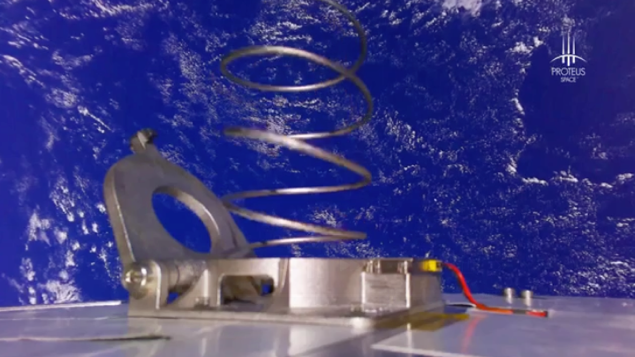
JPL 3D-Printed Part Springs ForwardDescription With a simple motion, a jack-in-the-box-like spring designed at NASA’s Jet Propulsion Laboratory showed the potential of additive manufacturing, also known as 3D printing, to cut costs and complexity for futuristic space antennas. Called JPL Additive Compliant Canister (JACC), the spring deployed on the small commercial spacecraft Proteus Space’s Mercury One on Feb. 3, 2026. […]
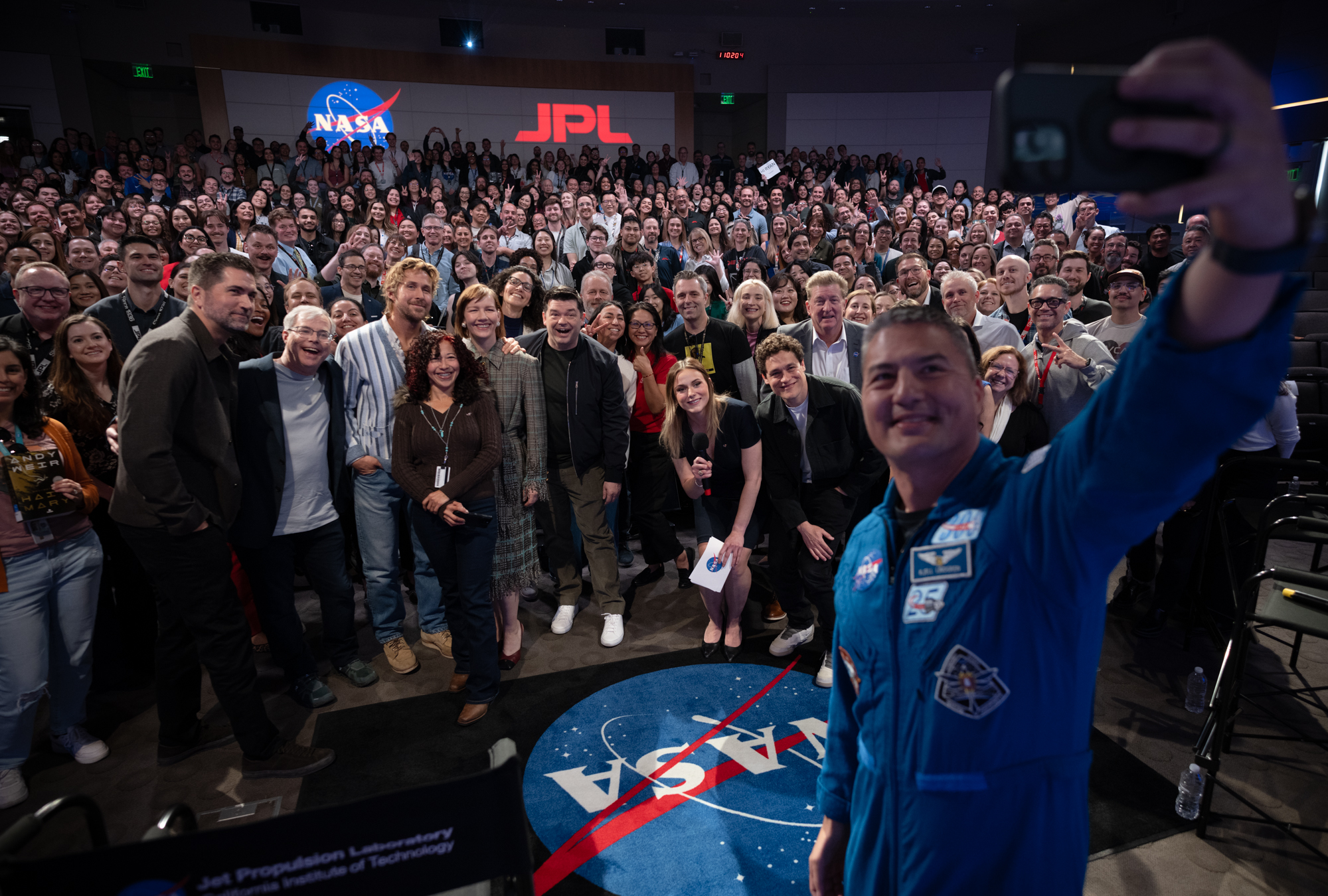
Inside Project Hail MaryNASA astronaut and deputy director of the Flight Operations Directorate Kjell Lindgren takes a selfie with panelists and the audience at the agency’s Jet Propulsion Laboratory on Feb. 25, 2026. Actors Ryan Gosling and Sandra Huller, screenwriter Drew Goddard, directors Phil Lord and Christopher Miller, and producer and writer of the “Project Hail Mary” novel […]
CesiumAstro acquires Vidrovr to embed AI in communications systemsSAN FRANCISCO – CesiumAstro announced the acquisition Feb. 26 of Vidrovr, a startup that specializes in artificial intelligence for multimodal signals analysis. Terms of the transaction, which closed in late 2025, were not disclosed. CesiumAstro acquired Vidrovr to accelerate its campaign to embed AI in space telecommunications and intelligence, surveillance and reconnaissance infrastructure, enabling radio-frequency […] The post CesiumAstro acquires Vidrovr to embed AI in communications systems appeared first on SpaceNews.
World-first gigabit-per-second laser link between aircraft and geostationary satelliteFaster, more secure connections from space could one day make broadband on planes, ships and even remote roads as easy as turning on a light. The European Space Agency (ESA), Airbus Defence and Space, the Netherlands Organisation for Applied Scientific Research (TNO) and German payload manufacturer TESAT (as subcontractor) successfully connected an aircraft to a geostationary satellite using laser communications, bringing people closer to seamless, high‑speed connections in daily life.
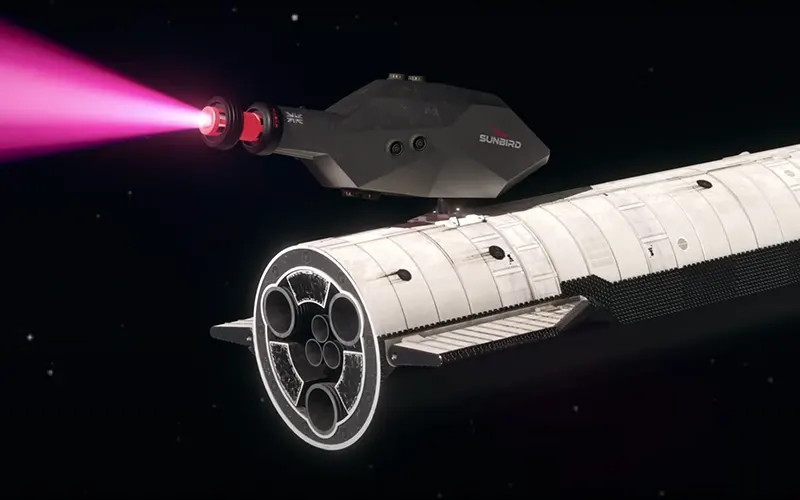
UKAEA to Help Pulsar Fusion with Shielding for Nuclear Propulsion SystemUK-based in-orbit propulsion systems provider Pulsar Fusion has announced that the UK Atomic Energy Authority will assist the company with the development of neutron shielding and activation modelling for its Sunbird Migratory Transfer Vehicle. In March 2025, Pulsar Fusion unveiled its Sunbird Migratory Transfer Vehicle, which it claimed had been developed “in complete secrecy over […] The post UKAEA to Help Pulsar Fusion with Shielding for Nuclear Propulsion System appeared first on European Spaceflight.
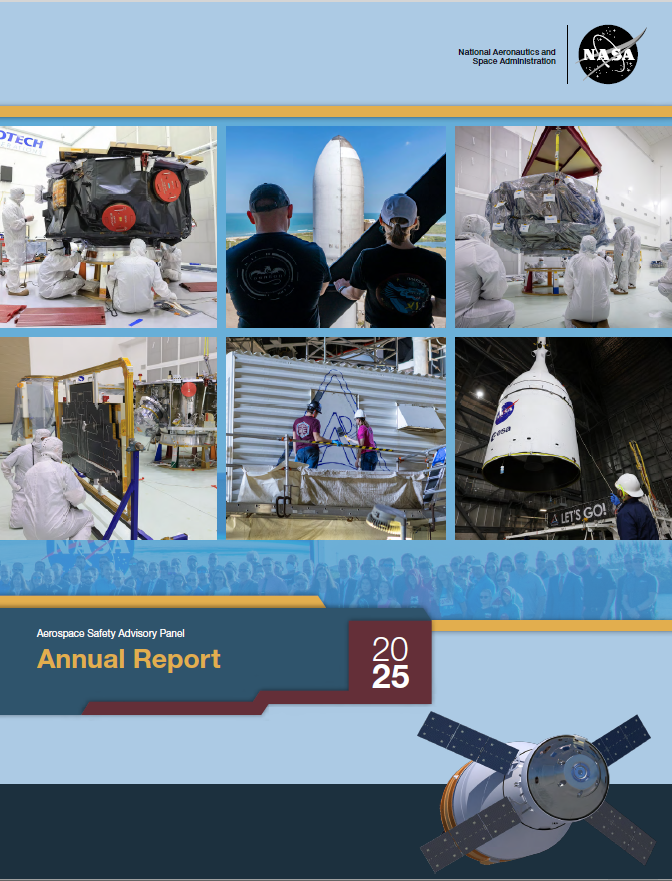
NASA’s Aerospace Safety Advisory Panel Releases 2025 Annual ReportThe Aerospace Safety Advisory Panel (ASAP), which advises NASA and Congress on safety, has released its 2025 annual report on NASA’s performance and challenges. While the panel acknowledged NASA’s safety achievements, it warned that the agency’s biggest challenges stem from interconnected factors – workforce, acquisition, technical authority, budgets, and the growing complexity of human spaceflight – requiring sustained attention as missions become more ambitious. “Independent […]
The future of astronomy is both on Earth and in spaceA recent SpaceNews opinion article argued that it is time to “take astronomy off Earth.” The suggestion is straightforward: If satellite constellations and commercial space activity threaten ground-based astronomy, perhaps astronomers should simply move their work into space. As current, incoming and past presidents of the American Astronomical Society, we feel impelled to respond. As […] The post The future of astronomy is both on Earth and in space appeared first on SpaceNews.
In space traffic coordination, the biggest challenge may be coordinationAs the number of satellites in orbit grows, one emerging challenge is the difficulty some satellite operators have contacting counterparts to avoid potential collisions. The post In space traffic coordination, the biggest challenge may be coordination appeared first on SpaceNews.
Rare lensed supernova offers new route to measure cosmic expansionLondon (SDX) Feb 25, 2026 That the universe is expanding has been known for almost a century, but its exact rate of expansion remains one of cosmology's most hotly debated questions. A team from the Technical University of Munich (TUM), Ludwig Maximilians University (LMU) and the Max Planck Institutes for Astrophysics (MPA) and for Extraterrestrial Physics (MPE) has now imaged and modelled an exceptionally rare supernova